
The short answer: A cross-connect is a direct, physical cable — usually fiber, sometimes copper — that links your equipment to another party’s equipment inside the same data center, such as a carrier, an internet exchange, a cloud on-ramp, or a business partner. Because traffic never touches the public internet, a cross-connect delivers lower latency, higher reliability, and better security than routing the same traffic over the open web. Most colocation providers charge a one-time setup fee plus a monthly recurring fee per cross-connect, and those fees vary widely from facility to facility.
If you are comparing colocation providers, cross-connects deserve more attention than they usually get. Rack space and power are easy to compare on a quote. Cross-connect pricing and availability are often buried in the fine print — yet they decide how many carriers you can reach, how quickly you can add a new network, and what your connectivity bill looks like three years from now.
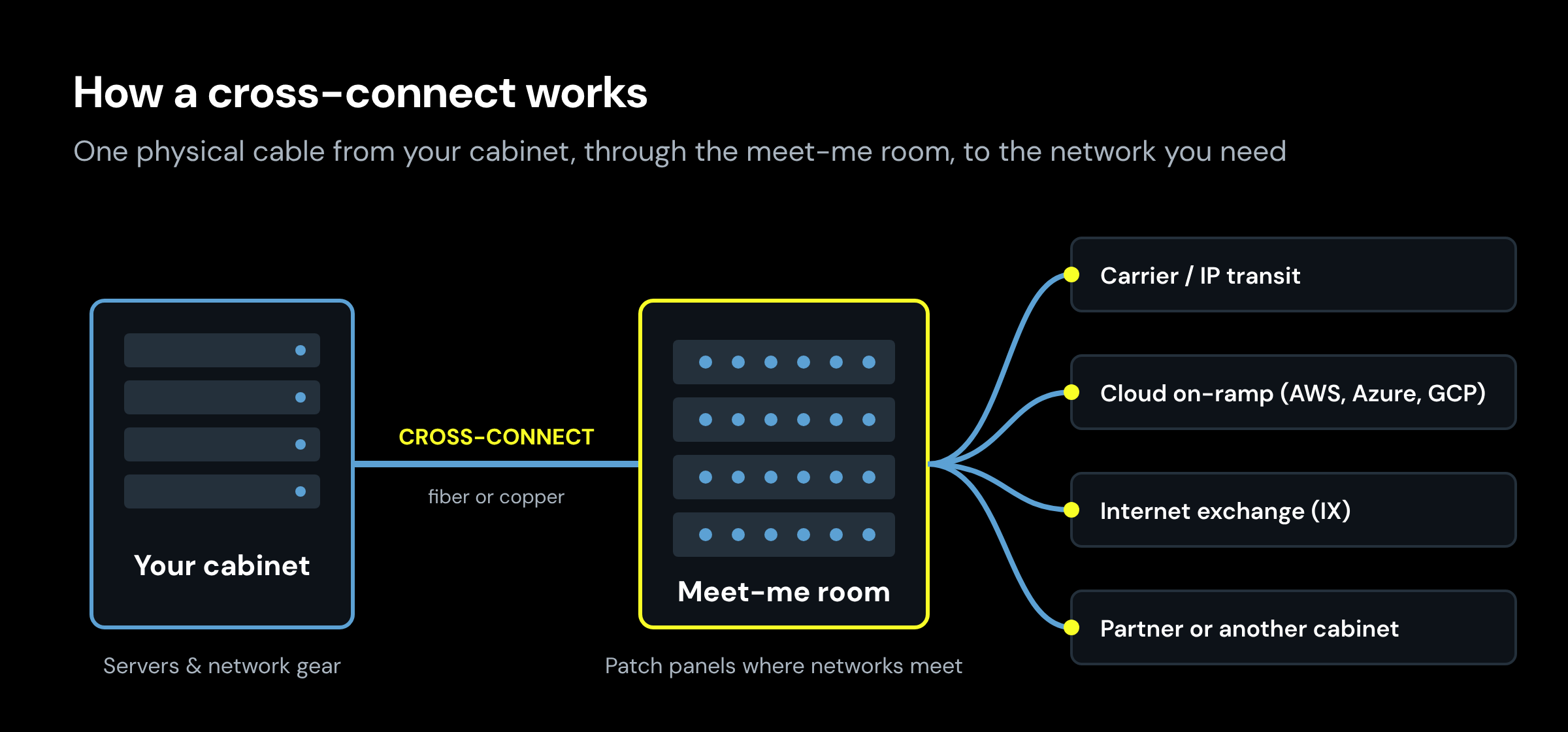
A cross-connect is a point-to-point cable run between two customers’ equipment in the same facility. The data center operator installs and manages the physical path: a cable runs from your cabinet to a patch panel in a meet-me room (MMR), and from there to the cabinet or panel of the network, cloud, or partner you want to reach.
Once it is in place, the two parties exchange traffic directly. There is no third-party network in the middle, no public internet hop, and no shared bandwidth with other customers. That is why cross-connects are the foundation of everything from IP transit and peering to private links into AWS, Microsoft Azure, and Google Cloud.
Ordering and provisioning a cross-connect usually follows the same steps at any facility:
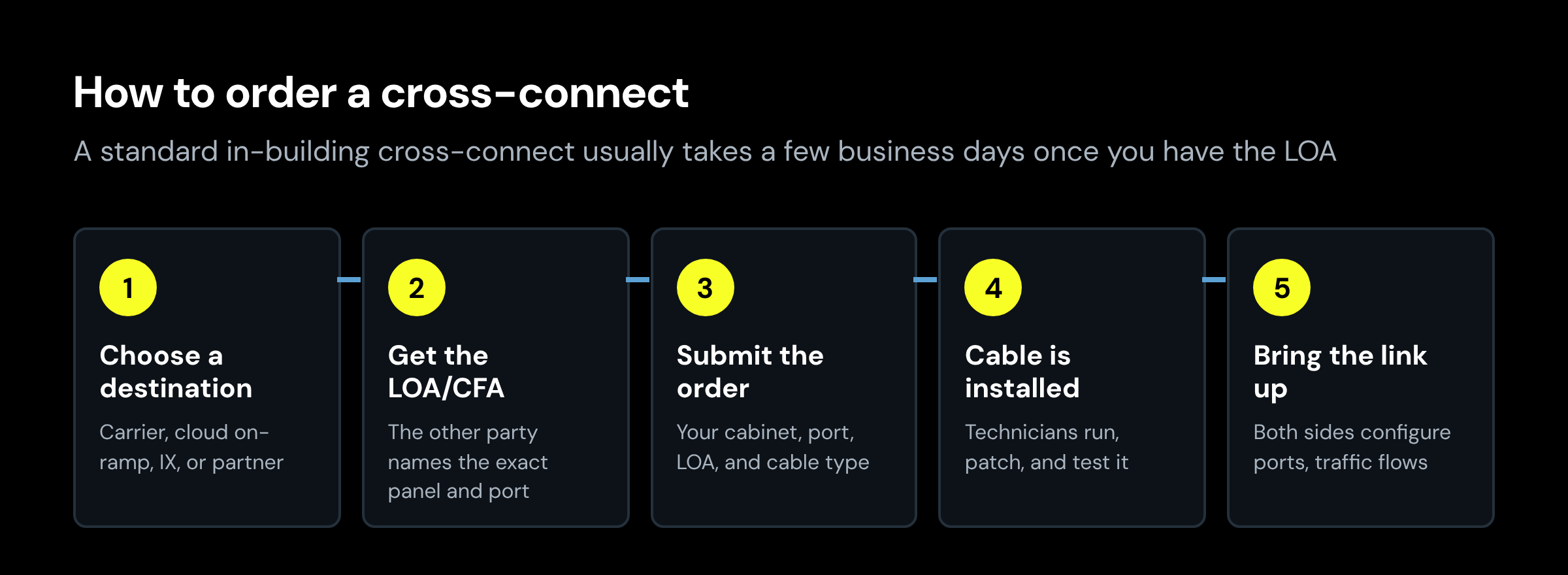
In most facilities, a standard in-building cross-connect is completed in a few business days once the LOA is in hand.
| Type | What it connects | Common use |
|---|---|---|
| Single-mode fiber | Long or high-speed runs between cabinets, cages, or the meet-me room | Carrier circuits, 10G/100G+ links, cloud on-ramps |
| Multi-mode fiber | Shorter high-speed runs, typically within the same room or floor | Links between your own cabinets or nearby partners |
| Copper (Cat6/Cat6a) | Short Ethernet runs at 1G/10G | Management networks, out-of-band access, legacy gear |
| Coax | Specialized telecom and broadcast handoffs | Media and legacy telecom circuits |
| Rack-to-rack (intra-customer) | Two of your own cabinets in the same facility | Growing from one cabinet to several without re-architecting |
| Campus / building-to-building | Your equipment and a network in a nearby facility via dark fiber or lit transport | Reaching carrier hotels and exchanges in other buildings |
Cross-connect pricing generally has two parts:
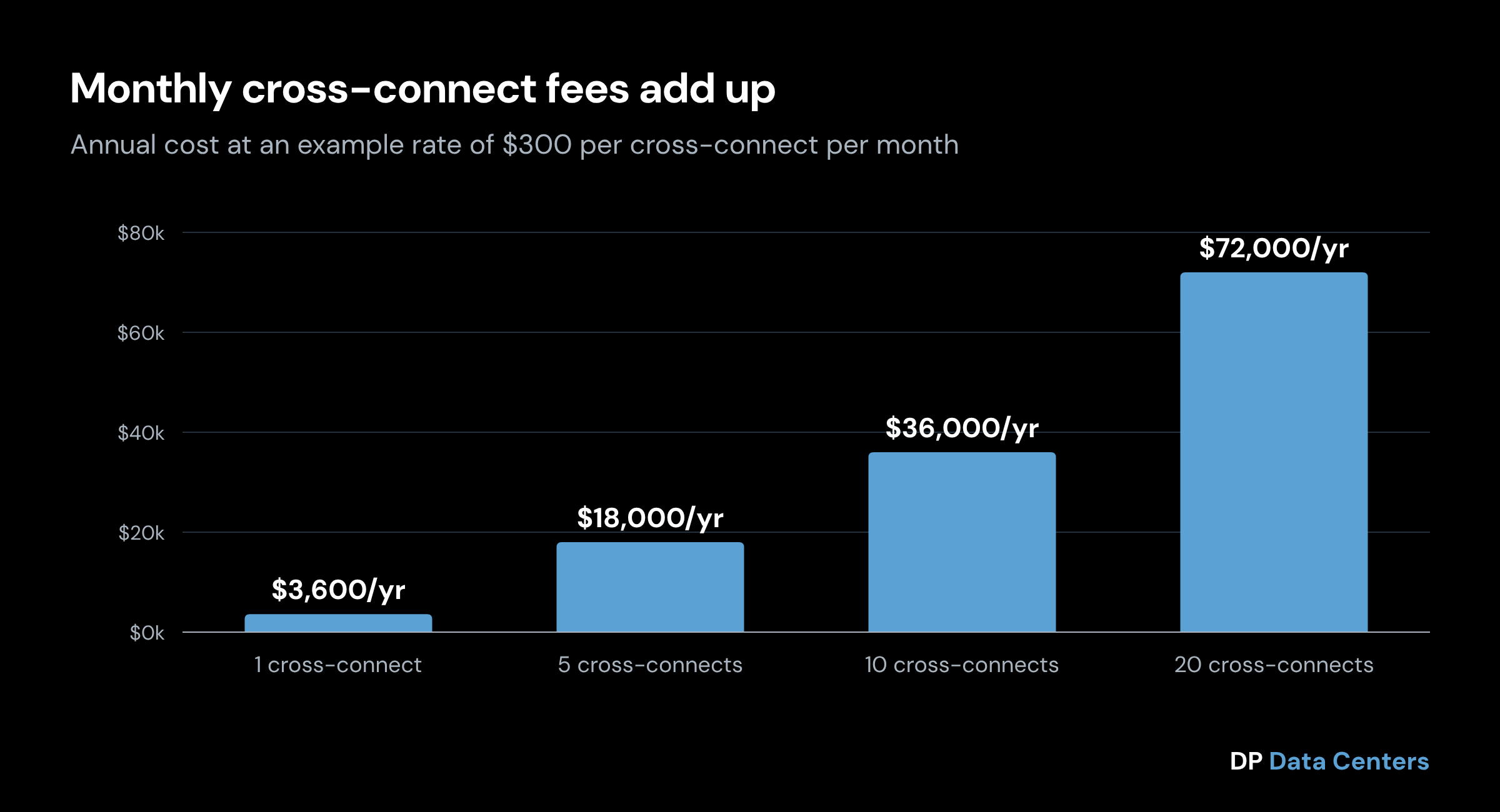
At large, interconnection-focused colocation providers, monthly fees of a few hundred dollars per fiber cross-connect are common — and those fees apply to every connection, including links between your own cabinets. Because the charge recurs every month for the life of your contract, cross-connects can quietly become one of the largest line items on a colocation bill. A deployment with 10 cross-connects at $300 per month spends $36,000 per year on cables alone, before power, space, or bandwidth.
Independent and regional facilities often charge significantly less, and some do not charge at all for certain types, such as rack-to-rack connections within your own footprint. When you compare quotes, ask for cross-connect pricing in writing alongside space and power. Our guide to colocation pricing models covers the other cost components to compare.
| Option | What it is | Best for |
|---|---|---|
| Cross-connect | Dedicated physical cable to one party in the same facility | High-volume or latency-sensitive traffic to a specific carrier, cloud, or partner |
| Internet exchange (IX) port | One connection to a shared switching fabric where many networks peer | Exchanging traffic with many networks at once (see What Is an IXP?) |
| IP transit | Paid access to the full internet through an upstream provider | Reaching destinations you do not connect to directly |
| Cloud on-ramp | Private link to AWS Direct Connect, Azure ExpressRoute, or Google Cloud Interconnect | Hybrid IT with predictable performance and lower egress costs |
In practice these work together: an IX port and a cloud on-ramp are both typically delivered over a cross-connect. For more on combining them, see Interconnection Strategies for Hybrid IT Environments.
Downtown Los Angeles is one of the most interconnected places in the western United States. Buildings such as One Wilshire, 600 W 7th, and 900 N Alameda form a dense fiber network that links Pacific subsea cable systems, major carriers, and cloud providers. That density is a big part of why downtown LA is a top data center market.
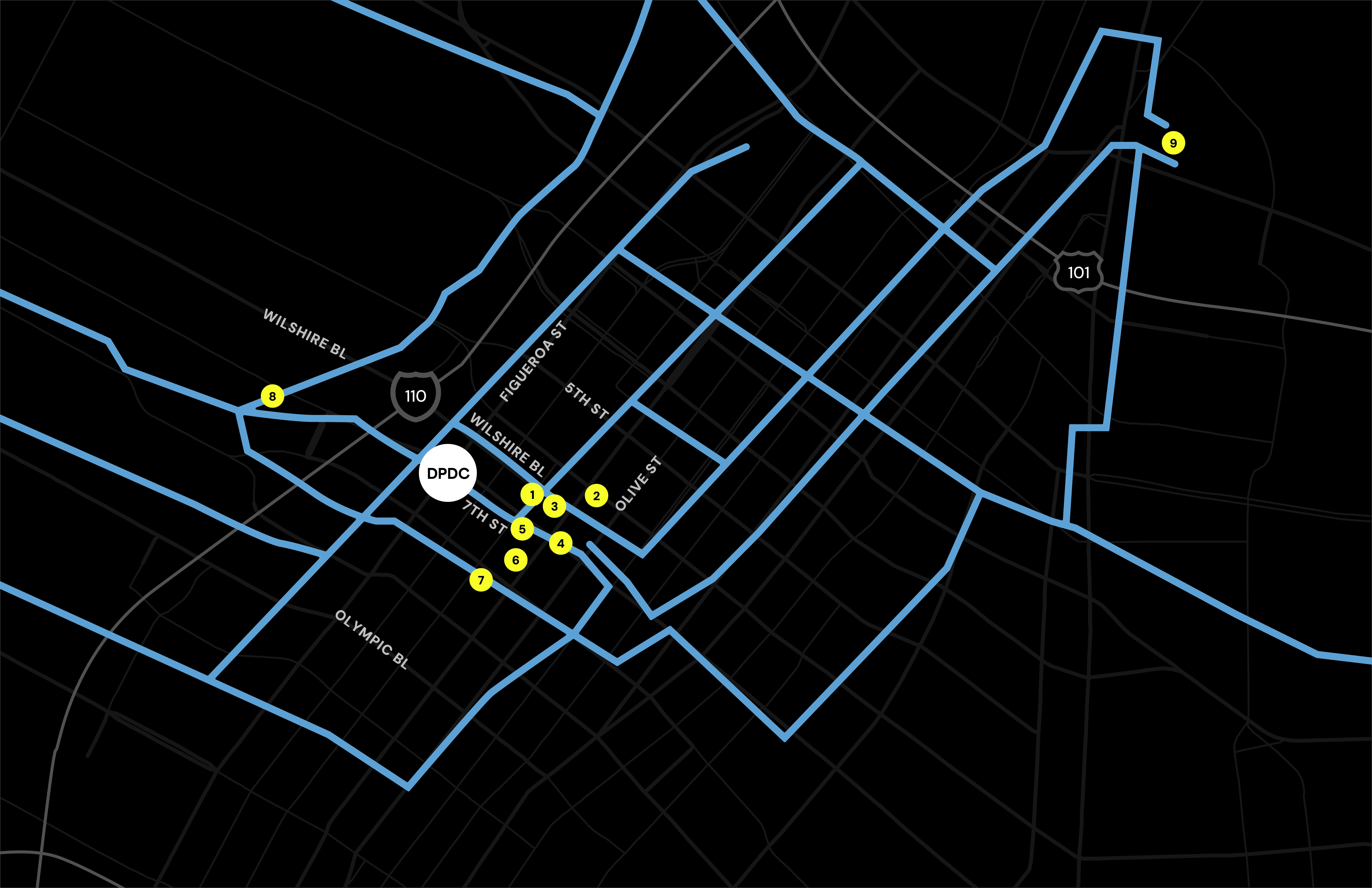
DP Data Centers at 818 West 7th Street sits inside that network. Tier 1 and regional carriers on-site include Lumen, AT&T, Verizon, Zayo, Crown Castle, Frontier, and others, with primary fiber routes to One Wilshire, 600 W 7th (Digital Realty LAX10 and Equinix LA1), 900 N Alameda (CoreSite LA2 and LA3), and other DTLA facilities. Cloud connectivity to AWS, Microsoft Azure, and Google Cloud is available.
Unlike many interconnection-focused providers, DPDC charges cross-connect fees well below typical market rates and does not charge for rack-to-rack cross-connects within the data center — so you can grow from one cabinet to many without your connectivity bill growing with it. See our colocation and connectivity services or request a quote.
“Interconnection” is the broad term for linking networks together. A cross-connect is the specific physical cable that makes an interconnection happen inside a data center. Most interconnection services, including IX ports and cloud on-ramps, are delivered over one or more cross-connects.
A meet-me room (MMR) is a secure, centralized area of a data center where carriers and customers terminate their cables on patch panels. Cross-connects are patched through the MMR, which lets networks connect to each other without entering each other’s cages or cabinets.
A Letter of Authorization and Connecting Facility Assignment (LOA/CFA) is a document from the party you are connecting to. It authorizes the data center to connect to their equipment and specifies the exact panel and port. The data center will not install a cross-connect without one.
A standard cross-connect within a single building is usually completed within a few business days of receiving a valid LOA. Connections that involve another building, new fiber construction, or a carrier’s own provisioning can take longer.
To use a private cloud connection such as AWS Direct Connect, Azure ExpressRoute, or Google Cloud Interconnect from a colocation facility, you typically need a cross-connect to the cloud on-ramp or to a network provider that carries the connection to the cloud provider.
Cross-connect fees are a major source of recurring revenue for large interconnection-focused providers, and they are charged per connection, every month, for the life of the contract. Independent facilities often price them closer to the actual cost of installation and maintenance.
© 2025 Downtown Properties LLC. All rights reserved.